Industrial Bulk Flour Handling & Dosing Systems
Industrial Bulk Flour Handling & Dosing Systems:
How Large Mills and Bakeries Cut Waste, Dust and Downtime
The Flour looks simple, but moving and dosing it at industrial scale is not. In a large mill, a commercial bakery, or a pasta or noodle plant in the USA, Canada or Mexico knows the problems: inconsistent batches, dust, contamination risk, labor costs and unplanned stoppages. Each one costs money every shift.
This article covers the most common pain points in bulk flour handling and how a modern, automated system solves them.
The 6 Biggest Pain Points in Bulk Flour Handling
1. Inconsistent recipes and batch variation. Manual or semi-manual weighing leads to over- and under-dosing. Across thousands of batches, small errors add up to wasted ingredients, rejected product and inconsistent quality for your customers.
2. Food safety and regulatory pressure. North American plants operate under FSMA and HACCP in the USA, SFCR in Canada, and COFEPRIS and SENASICA requirements in Mexico. Open handling, manual bag dumping and poor sanitary design raise cross-contamination and allergen risks.
3. Dust and explosion hazard. Flour dust is combustible. Under NFPA 61 and NFPA 652 guidance, dust control is a safety obligation, not a housekeeping choice. Open transfer points and leaky conveying make the risk worse.
4. Rising labor costs and shortages. Manual sack handling is slow, physically demanding and hard to staff. Many plants now want to move people from lifting bags to supervising the process.
5. Product damage and waste. Mechanical conveyors can cause degradation, spillage and residue build-up. Product left in the line is lost yield.
6. Poor traceability. Auditors and retail customers increasingly expect batch records, lot tracking and proof that each recipe was followed exactly.
The Solution: An Integrated Bulk Flour Handling & Dosing System
Immy Hitech's bulk flour handling and dosing system is designed as one closed, automated line from silo to mixer. It replaces separate manual steps with a controlled process.
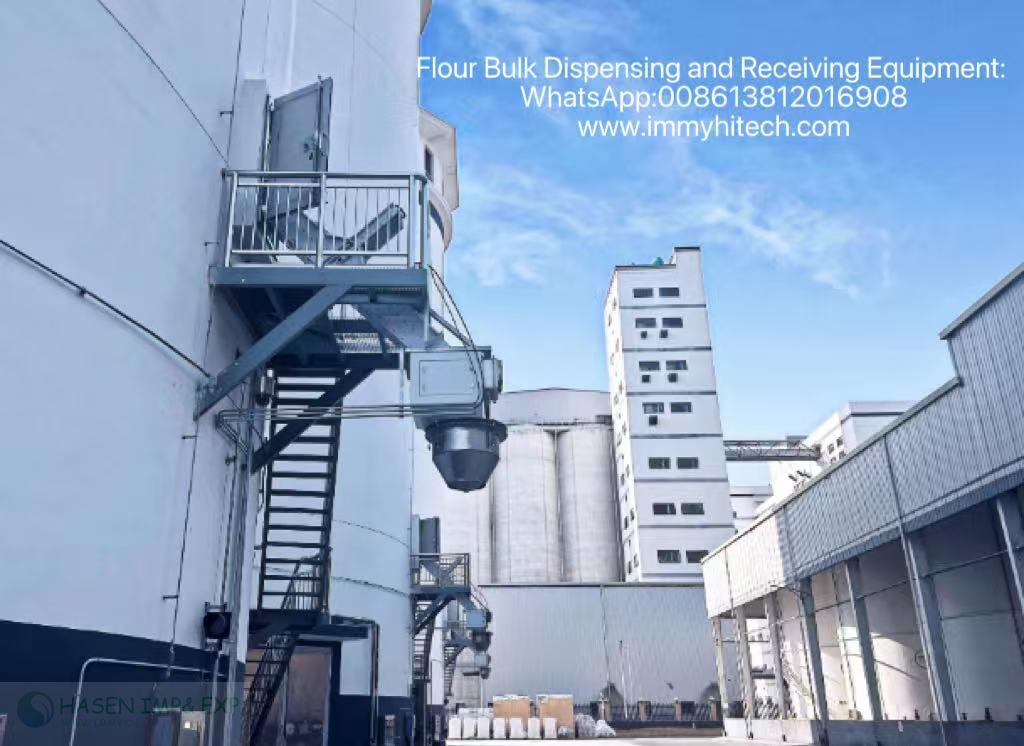
1. Silo Storage and Discharge
Bulk flour is stored in silos fed directly from tanker trucks or rail cars. Proper discharge aids and fluidization keep flour flowing and prevent bridging and rat-holing, so material leaves the silo consistently.
2. Pneumatic Conveying
Flour travels through sealed pipelines, either dilute-phase or dense-phase pneumatic conveying depending on your product and layout. Benefits include:
Dust-free transfer. A closed system reduces airborne flour and housekeeping burden.
Flexible routing. Pipes go around obstacles and between floors far more easily than belts or screws.
Hygienic design. There are fewer open surfaces and moving parts to clean.
Gentle handling. Correct system design helps protect product quality.
3. Precision Dosing and Weighing
Load-cell-based dosing units weigh each ingredient (flour types, and optionally minor ingredients) to the exact recipe target. Automated weighing removes operator error and gives repeatable results batch after batch.
4. PLC Recipe Control
A PLC control system, usually with a touchscreen HMI, is the brain of the line. It lets you:
Store and recall multiple recipes
Control silo selection, conveying, dosing and mixer loading automatically
Record batch data for traceability and audits
Raise alarms for low levels, blockages or out-of-tolerance weights
Integrate with plant SCADA or ERP systems where required
5. Delivery to the Mixer
Finished doses go directly to the mixer, with no manual lifting and no open transfer. This keeps the process clean and keeps the mixer running on schedule.
Scalable From 500 kg/hr to 100 Tons/hr
One reason plants choose this approach is scalability. We engineer systems across a wide range:
| Plant type | Typical capacity |
|---|
| Small to mid-size bakery or food plant | 500 to 2,000 kg/hr |
| Large commercial bakery, pasta or noodle plant | Several tons/hr |
| Large industrial flour mill or bulk distribution | Up to 100 tons/hr |
You can start with a smaller line and design the layout so capacity can expand as demand grows.
Measurable Benefits for Your Plant
Better consistency. Automated dosing reduces variation between batches.
Less waste. Accurate weighing and closed conveying reduce ingredient loss and spillage.
Improved safety and cleanliness. Lower dust levels support safer working conditions and easier compliance.
Lower labor dependence. Fewer manual tasks, fewer lifting injuries and better use of skilled staff.
Full traceability. Digital batch records make audits and customer reviews easier.
Higher uptime. Automated flow means fewer stoppages waiting for ingredients.
Actual results depend on your current process, product and layout. That is why we start with a site-specific assessment rather than an off-the-shelf package.
Who Is This System For?
Industrial flour mills and blending facilities
Large commercial and industrial bakeries
Tortilla and flatbread producers (a major segment in Mexico and the USA)
Pasta, noodle and snack manufacturers
Biscuit, cracker and confectionery plants
Food ingredient and premix companies
What to Ask Before Choosing a Supplier
Can the system be designed around your plant layout, product and target throughput?
Is the pneumatic conveying method matched to your flour type?
Does the PLC support your recipe complexity and traceability needs?
Is the design suitable for sanitary standards and dust-control requirements in your region?
What commissioning, training and spare-parts support is provided?
Frequently Asked Questions
What capacity range do your bulk flour handling systems cover?
From 500 kg/hr for smaller plants up to 100 tons/hr for large industrial installations.
Is pneumatic conveying suitable for flour?
Yes. When correctly engineered, it moves flour through closed pipelines, reducing dust and contamination while allowing flexible plant layouts.
Can the system handle multiple recipes?
Yes. PLC recipe control stores multiple formulations and runs the silo-to-mixer sequence automatically.
Can it be integrated into an existing plant?
In most cases, yes. We review your current silos, mixers and layout, then design the system to fit.
Talk to an Engineer About Your Flour Handling Challenge
Every plant is different. Tell us your flour type, daily throughput, layout and current pain points, and our team will recommend a system that fits.
Request a free consultation and quotation: www.immyhitech.com
Email / WhatsApp: [add your contact details]
Keywords used: bulk flour handling system, flour dosing system, pneumatic conveying flour, silo to mixer, PLC recipe control, industrial flour handling USA / Canada / Mexico.
Tips to help this rank on Google and AI search
Add real proof. A case study, photos of installed systems, customer names (with permission) and certifications (CE, ISO and so on) matter most for both Google and AI answers.
Use FAQ schema markup on the FAQ section so Google and AI tools can quote it.
Add a system diagram with a descriptive alt text such as "silo to mixer pneumatic flour conveying diagram".
Publish consistently. Post shorter articles on topics like "dense-phase vs dilute-phase conveying for flour" or "NFPA 61 dust control for bakeries", and link them to this page.
Share on LinkedIn and Facebook with a short summary and a link. Engaging posts from your company page and personal profile help visibility.
Keep your company profile consistent across your website, LinkedIn, Google Business Profile and directories, since AI tools rely on consistent information.



 Call us:
 Wuxi Hasen sales